Image: Liam Goodner (via Shutterstock)
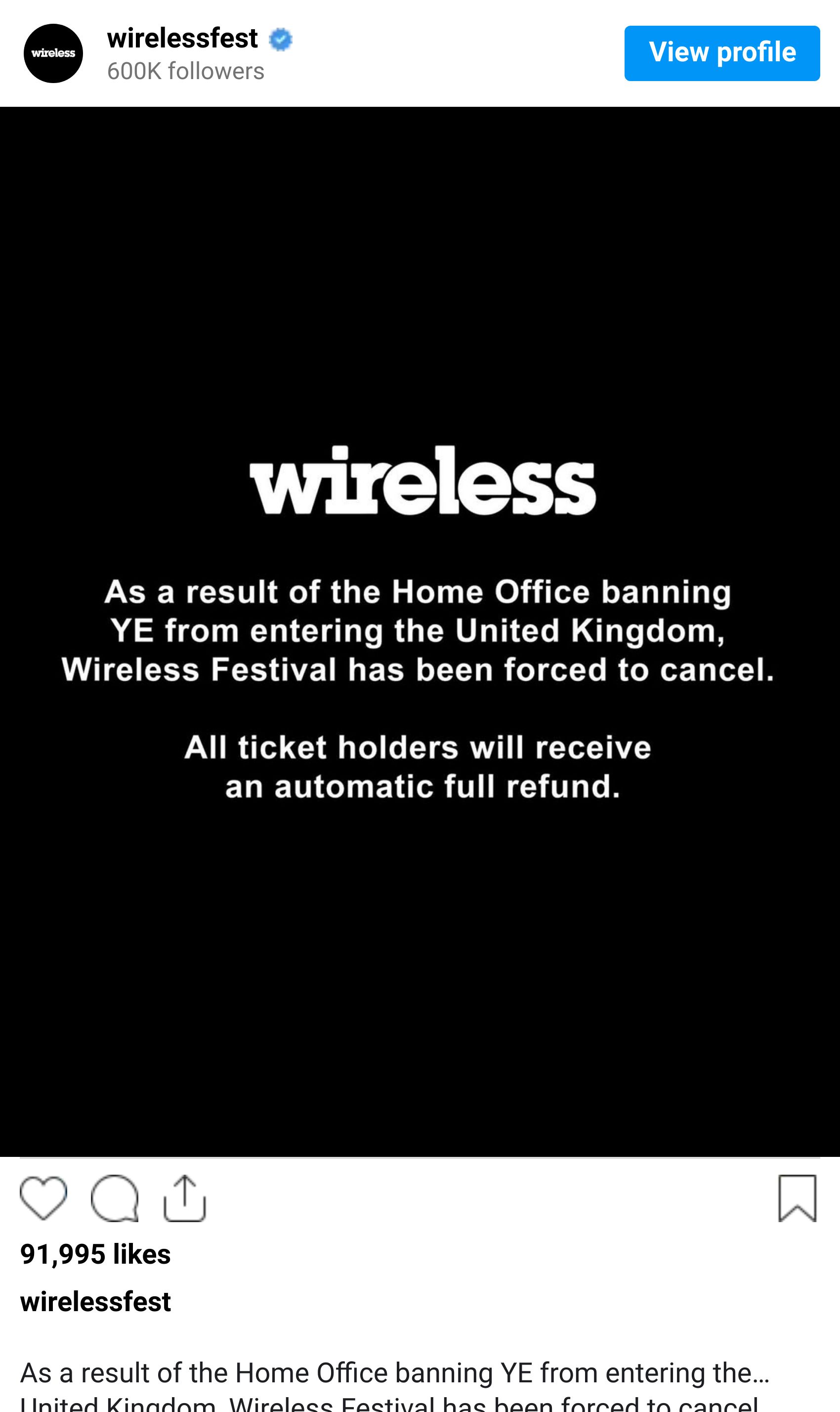
Wireless Festival has been canceled after Ye, the artist formerly known as Kanye West, was denied entry into the United Kingdom, bringing days of controversy around his headline booking to an abrupt end. Organizers confirmed the cancellation after the UK Home Office withdrew Ye’s Electronic Travel Authorisation, and Wireless said all ticket holders will receive an automatic full refund.
The festival’s collapse follows a rapidly escalating backlash that began when Ye was announced as the headliner for all three nights of the London event, scheduled for July 10 to 12 in Finsbury Park. Critics pointed to his long record of antisemitic remarks and more recent Nazi-related provocations, which reignited pressure on both the festival and the UK government.
As the backlash grew, major corporate partners began stepping away. Reuters, AP, and other outlets reported that sponsors, including Pepsi and Diageo, withdrew from the festival, turning what was already a reputational problem into a commercial one as well.
Go from AI overwhelmed to AI savvy professional

AI will eliminate 300 million jobs in the next 5 years.
Yours doesn't have to be one of them.
Here's how to future-proof your career:
Join the Superhuman AI newsletter - read by 1M+ professionals
Learn AI skills in 3 mins a day
Become the AI expert on your team
The political pressure rose just as quickly. Prime Minister Keir Starmer publicly criticized the booking, while other British officials and Jewish organizations argued Ye should not be allowed to perform in the country. Festival Republic initially stood by the decision, with promoter Melvin Benn defending the booking and urging critics to allow for redemption, but the government’s decision ultimately made the event impossible to stage.
According to the reporting, the Home Office revoked Ye’s entry permission on the basis that his presence was not considered conducive to the public good. That ruling effectively ended any realistic path forward for the festival, which had built its 2026 edition around his appearance. Wireless then posted a short statement confirming the cancellation and refunds.
The episode has become a case study in how quickly a major music event can unravel when artist controversy, sponsor risk, and government intervention all collide at once. What began as a bold booking became a full-scale crisis, and by the end of it, Wireless was no longer defending its lineup. It was shutting down the festival entirely.